SingLet logo SingLet™ Sing + Letter

Pedagogical Method Comparison

A short Amazing Grace excerpt in B-flat major can show what different pedagogies preserve, foreground, or suppress when musicians sing from notation. B-flat major is chosen because it includes both the hard-to-sing natural note F and the flat note B-flat.

Shared Melody

One-line Amazing Grace melody excerpt in B-flat major with original lyrics under the staff.

Melody: F B D B D C B G F, F B D B D C F

0:00.0 0:00.0
Full playback

Ready

Letter-Name Methods

These methods keep the note name itself in the foreground. They help learners connect notation directly to absolute pitch labels, and they are the most relevant family for SingLet.

Traditional Letter Names

Each written pitch is sung with its ordinary note name, so the melody reinforces conventional note-label identity directly.

B-flat major
Amazing Grace excerpt labeled with traditional letter names.

Melody: F B D B D C B G F, F B D B D C F

Syllable line: F B-flat D B-flat D C B-flat G F, F B-flat D B-flat D C F

0:00.0 0:00.0
Full playback

Ready

What It Preserves

Written pitch spelling, absolute note identity, and standard naming conventions.

Tradeoff

Natural note F as eff, and chromatic names such as B-flat or E-flat, remain accurate, but they are polysyllabic and can interrupt smooth legato singing.

Solfège and Solmization Methods

These approaches prioritize solmization syllables rather than letter names. Some are absolute systems tied to pitch classes, while others are relative systems tied to scale-degree function.

Traditional Fixed-Do

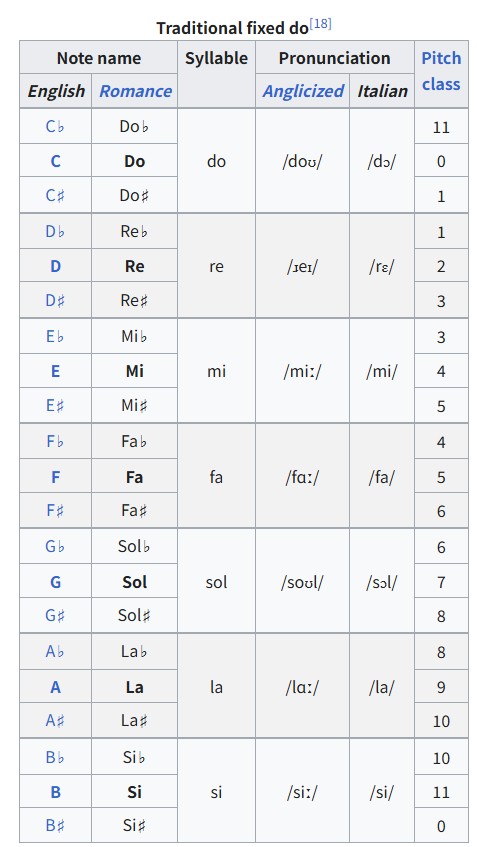
Traditional Fixed-Do always sings C as Do and D as Re, and so on. The natural-note syllable stays attached to the note letter, even when the pitch is sharpened or flattened, so B-flat is still sung with the B syllable family but at the B-flat pitch. Traditional Fixed-Do sings the 7th note as Si.

B-flat major
Amazing Grace excerpt labeled with traditional fixed-do syllables.

Melody: F B D B D C B G F, F B D B D C F

Syllable line: Fa Si* Re Si* Re Do Si* Sol Fa, Fa Si* Re Si* Re Do Fa

0:00.0 0:00.0
Full playback

Ready

Traditional fixed-do reference image from Wikipedia.

Image credit: Wikipedia.

What It Preserves

Absolute pitch-class identity at the letter level, but not a distinct sung syllable for each accidental spelling.

Tradeoff

It remains culturally familiar in many settings, but it under-encodes chromatic spelling because B, B-flat, and B-sharp all share the B-family syllable, and that likely hinders the development of absolute-pitch sense tied to these natural-note syllables.

Romance-Language Fixed-Do

This fixed-do variant keeps the absolute Do-Re-Mi framework while pronouncing accidentals in the Romance-language naming tradition. For example, Sib means Si bemol, which in plain English means B-flat.

B-flat major
Amazing Grace excerpt labeled with Romance-language fixed-do syllables.

Melody: F B D B D C B G F, F B D B D C F

Syllable line: Fa Sib Re Sib Re Do Sib Sol Fa, Fa Sib Re Sib Re Do Fa

0:00.0 0:00.0
Full playback

Ready

What It Preserves

Absolute pitch labeling within a widely recognized Romance-language naming practice.

Tradeoff

It remains explicit, but flat and sharp forms can lengthen the sung result in the same way that ordinary note names do.

Chromatic Fixed-Do

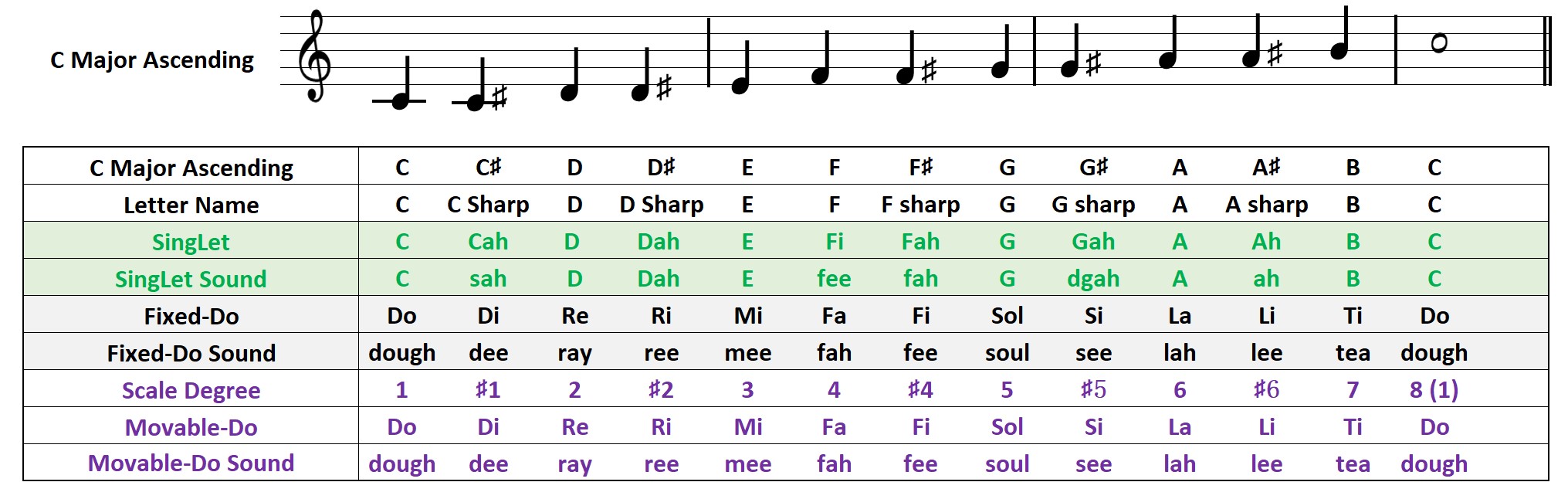
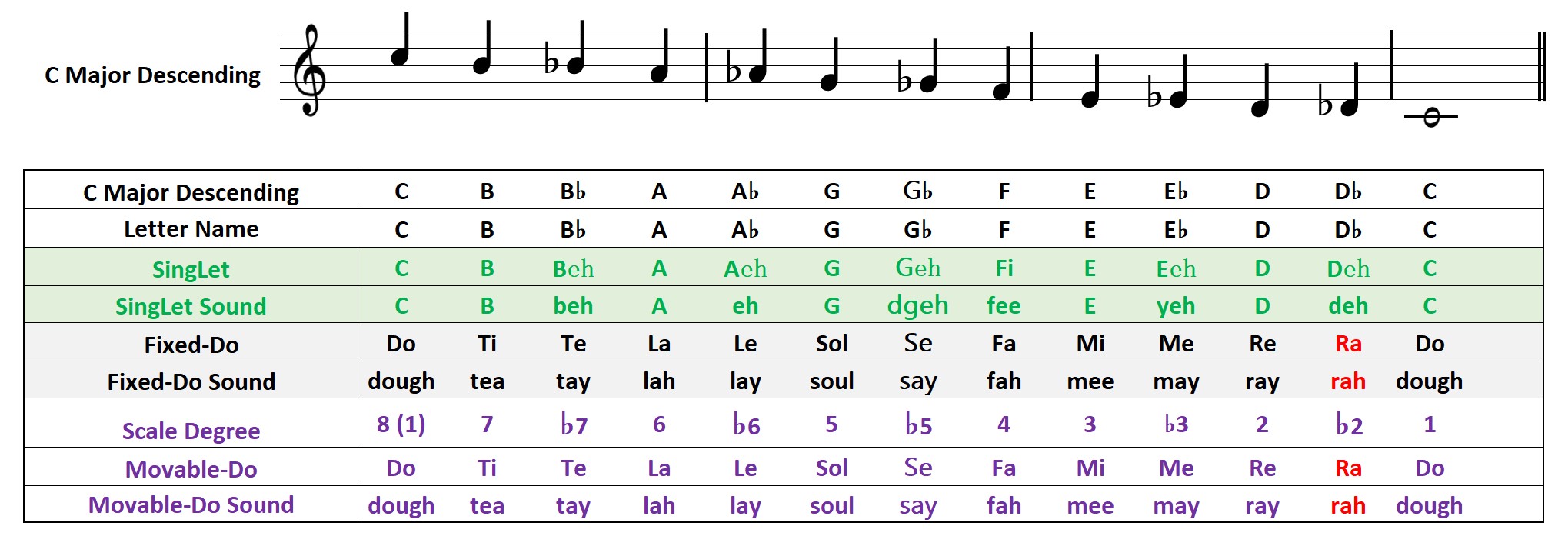
Chromatic Fixed-Do uses chromatic syllables within a fixed C-major frame: C remains Do, D remains Re, and the altered notes take dedicated chromatic syllables. The traditional Si is changed to Ti so it does not collide with the Sol-sharp syllable. A more detailed explanation appears at the end of this section in the ascending and descending chromatic reference images.

B-flat major
Amazing Grace excerpt labeled with chromatic fixed-do syllables.

Melody: F B D B D C B G F, F B D B D C F

Syllable line: Fa Te Re Te Re Do Te Sol Fa, Fa Te Re Te Re Do Fa

0:00.0 0:00.0
Full playback

Ready

C-major ascending chromatic scale showing fixed-do, movable-do, scale-degree, and SingLet syllables.
C-major descending chromatic scale showing fixed-do, movable-do, scale-degree, and SingLet syllables.

What It Preserves

Absolute pitch-class identity more distinctly than traditional fixed-do, especially when accidentals matter pedagogically. It also shows more clearly why long letter-name syllables become impractical for fluent singing once chromatic notes accumulate.

Tradeoff

It is more information-rich and more explicit about accidentals, but fixed-do still reuses syllables at different absolute pitches than movable-do, which makes it very likely ineffective for absolute-pitch skill development. SingLet is designed to overcome both the length problem of letter names and this fixed-do ambiguity, while also offering instant note recognition and awaiting broader adoption and testing for AP development.

Movable-Do

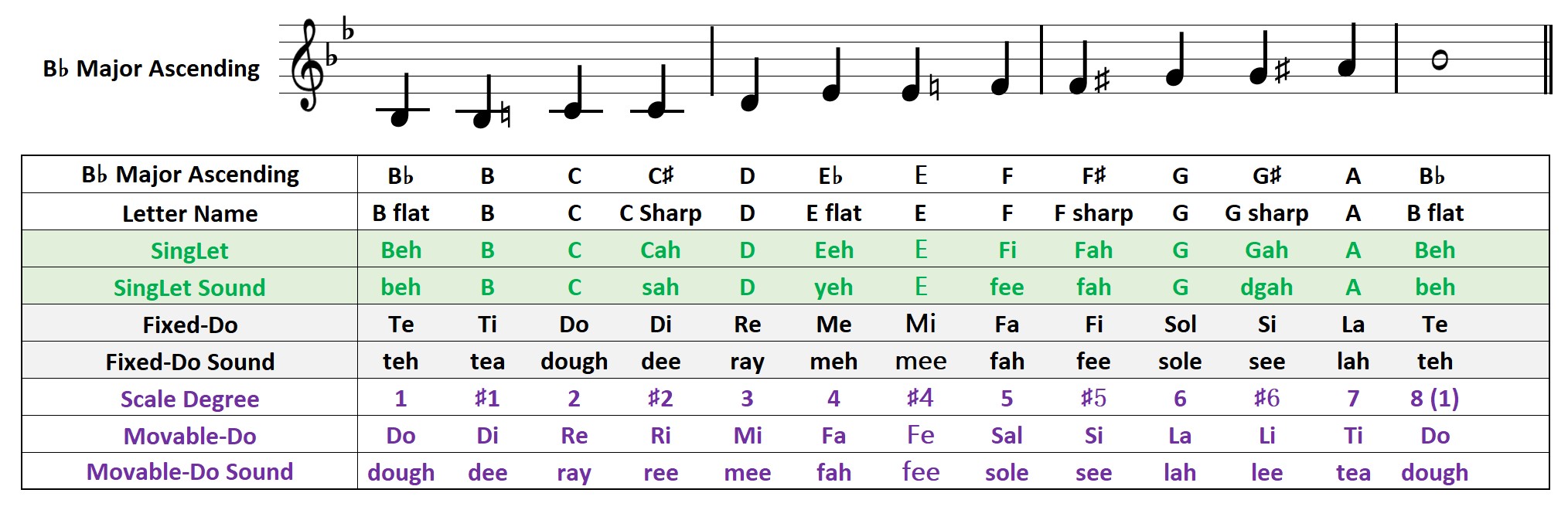
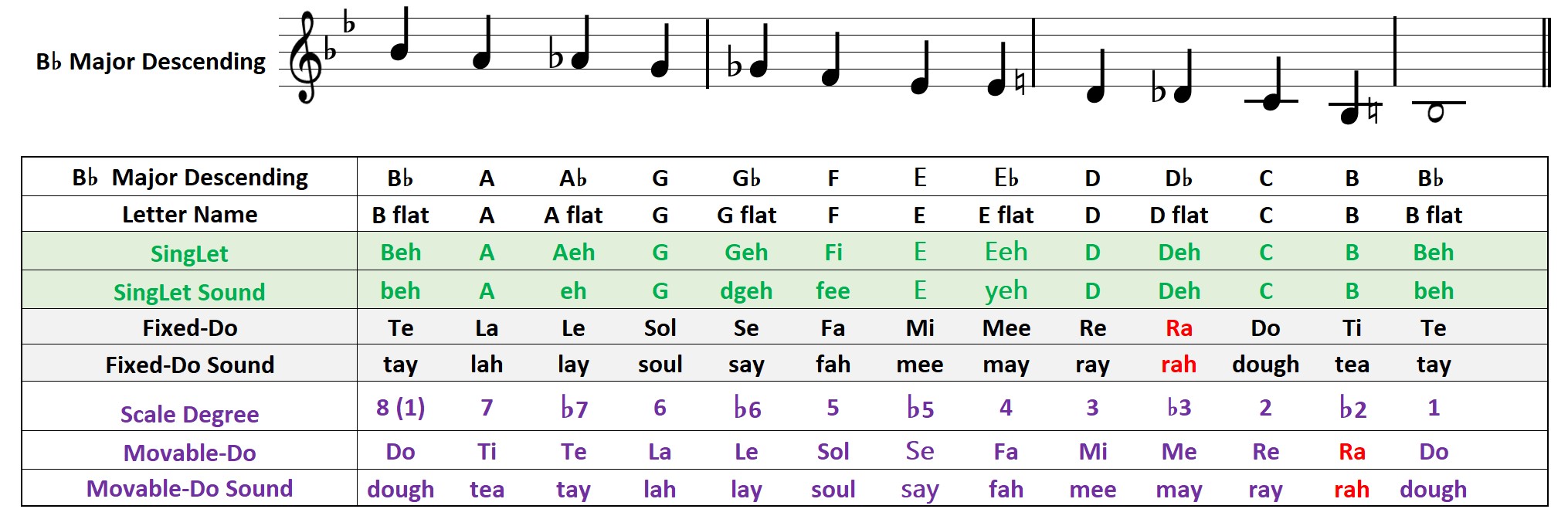
Movable-Do tracks scale-degree function rather than absolute note names. In B-flat major, the tonic B-flat becomes Do, D becomes Mi, and the opening F in the Amazing Grace excerpt becomes Sol because it functions as scale degree 5. A more detailed explanation appears at the end of this section in the B-flat-major ascending and descending chromatic reference images.

B-flat major
Amazing Grace excerpt labeled with movable-do syllables.

Melody: F B D B D C B G F, F B D B D C F

Syllable line: Sol Do Mi Do Mi Re Do La Sol, Sol Do Mi Do Mi Re Sol

0:00.0 0:00.0
Full playback

Ready

What It Preserves

Relative function, tonal pull, and scale-degree relationships within the key, making it ideal for relative-pitch development.

Tradeoff

It does not preserve absolute pitch spelling, so a transposition or enharmonic respelling can keep the same syllables while changing the written note identity.

B-flat-major ascending chromatic scale showing fixed-do, movable-do, scale-degree, and SingLet syllables.
B-flat-major descending chromatic scale showing fixed-do, movable-do, scale-degree, and SingLet syllables.

Neutral-Syllable Singing

Neutral-syllable methods intentionally suppress note-label information so singers can concentrate on line, breath, resonance, or pure audiation without a competing naming task.

Neutral Syllable

Every pitch is sung with the same neutral syllable, such as La, or other syllables such as Da, Ma, Ra, and so on, so the ear follows contour and interval without receiving note-name or solfège cues.

B-flat major
Amazing Grace excerpt labeled with neutral la syllables.

Melody: F B D B D C B G F, F B D B D C F

Syllable line: La La La La La La La La La, La La La La La La La

0:00.0 0:00.0
Full playback

Ready

What It Preserves

Pitch contour, interval hearing, and melodic shaping.

Tradeoff

It removes notated pitch identity almost completely, so it is weak for spelling-sensitive literacy by itself.

Neutral Vowel Singing

A single vowel such as Ah, or other vowels such as Ee, Oh, Oo, and so on, is sustained across the melody so the pedagogy focuses on resonance, airflow, and tone production rather than linguistic labeling.

B-flat major
Amazing Grace excerpt labeled with a neutral ah vowel.

Melody: F B D B D C B G F, F B D B D C F

Syllable line: Ah Ah Ah Ah Ah Ah Ah Ah Ah, Ah Ah Ah Ah Ah Ah Ah

0:00.0 0:00.0
Full playback

Ready

What It Preserves

Line continuity, vowel uniformity, and vocal-production consistency.

Tradeoff

Because there is almost no lexical contrast between pitches, it is the least informative choice for notation-based pitch recall.

Numbered Methods

These methods treat the melody as a pattern of degrees inside a key. They are analytically compact and often helpful when learners need a direct bridge between notation and tonal function.

Scale-Degree Numbers

Each note is identified by its degree in the governing scale, so the melody is expressed as functional positions within B-flat major rather than as pitch-class names.

B-flat major

Melody: F B D B D C B G F, F B D B D C F

Syllable line: 5 1 3 1 3 2 1 6 5, 5 1 3 1 3 2 5

0:00.0 0:00.0
Full playback

Ready

What It Preserves

Relative function, scalar location, and formal pattern repetition.

Tradeoff

Like movable-do, it does not preserve written note spelling or accidental family by itself.

Rhythmic / Rhythmatic Methods

Rhythmic approaches foreground duration, beat placement, and metric organization. On this page they use the same pitch contour preview, but their sung language is primarily about rhythm rather than pitch naming.

Rhythm Syllables

The singer uses rhythm-focused syllables to encode durations and subdivisions, while the pitch contour is retained only as a comparison frame.

B-flat major
Amazing Grace excerpt labeled with rhythm syllables.

Melody: F B D B D C B G F, F B D B D C F

Syllable line: ta | ta-a | ti-ti | ta-a | ta | ta-a | ta, ta ta ta | ti-ti ta ta | ta-a

0:00.0 0:00.0
Full playback

Ready

What It Preserves

Metric pulse, duration grouping, and subdivision awareness.

Tradeoff

It is strong for timing and weak for note-spelling identity unless paired with another pitch-label system.

Metric Counting

The singer counts metric position directly, using numbers or counts to anchor pulse, entrance, and duration more explicitly than a neutral pitch syllable would.

B-flat major

Melody: F B D B D C B G F, F B D B D C F

Syllable line: 3 | 1-2 | 3-and | 1-2 | 3 | 1-2 | 3, 1 2 3 | 1-and 2 3 | 1-2

0:00.0 0:00.0
Full playback

Ready

What It Preserves

Beat placement and metric structure.

Tradeoff

It is practical for coordination work, but it carries almost no note-spelling information unless combined with another approach.

Technical Notes

Why These Methods Matter

The categories on this page separate pedagogical goals that are often blurred together in classroom practice. A letter-name method answers "what written pitch is this?", a functional solmization answers "what role does this note play in the key?", a neutral-vowel drill answers "can I sustain this line fluently?", and a rhythmatic method answers "where does this sound fall in the meter?"

The comparison also exposes a practical singing problem: ordinary letter-name syllables are often too long to sing smoothly, especially once accidentals appear. Fixed-do shortens the syllables, but it reuses the same syllables for different written notes when the key center changes, so it is very likely ineffective for absolute-pitch skill development even while it remains useful in other forms of training.

SingLet is designed to overcome both obstacles by keeping note identities direct while remaining compact enough to sing fluently. It therefore offers instant note recognition in performance and is awaiting broader adoption and testing as a tool for absolute-pitch skill development. By contrast, the violet movable-do rows in the B-flat-major chromatic images align directly with scale degree in the same way they do in C major, which is why movable-do is so well suited to relative-pitch development.

Letter Names

Letter-name systems preserve exact note spelling, but syllables such as eff, B-flat, and E-flat are often too long for fluent singing.

Movable-Do

The violet movable-do row stays aligned with scale degree rather than fixed note name, so it keeps the same relative logic across keys and is excellent for relative-pitch development.

SingLet, Absolute Pitch (AP) and Relative Pitch (RP)

SingLet complements movable-do solfège by supporting a dual pathway: direct note-identity practice for AP development alongside scale-degree hearing for RP development.