A compact note-label system for naturals, accidentals, and higher tiers.
Nature Notes
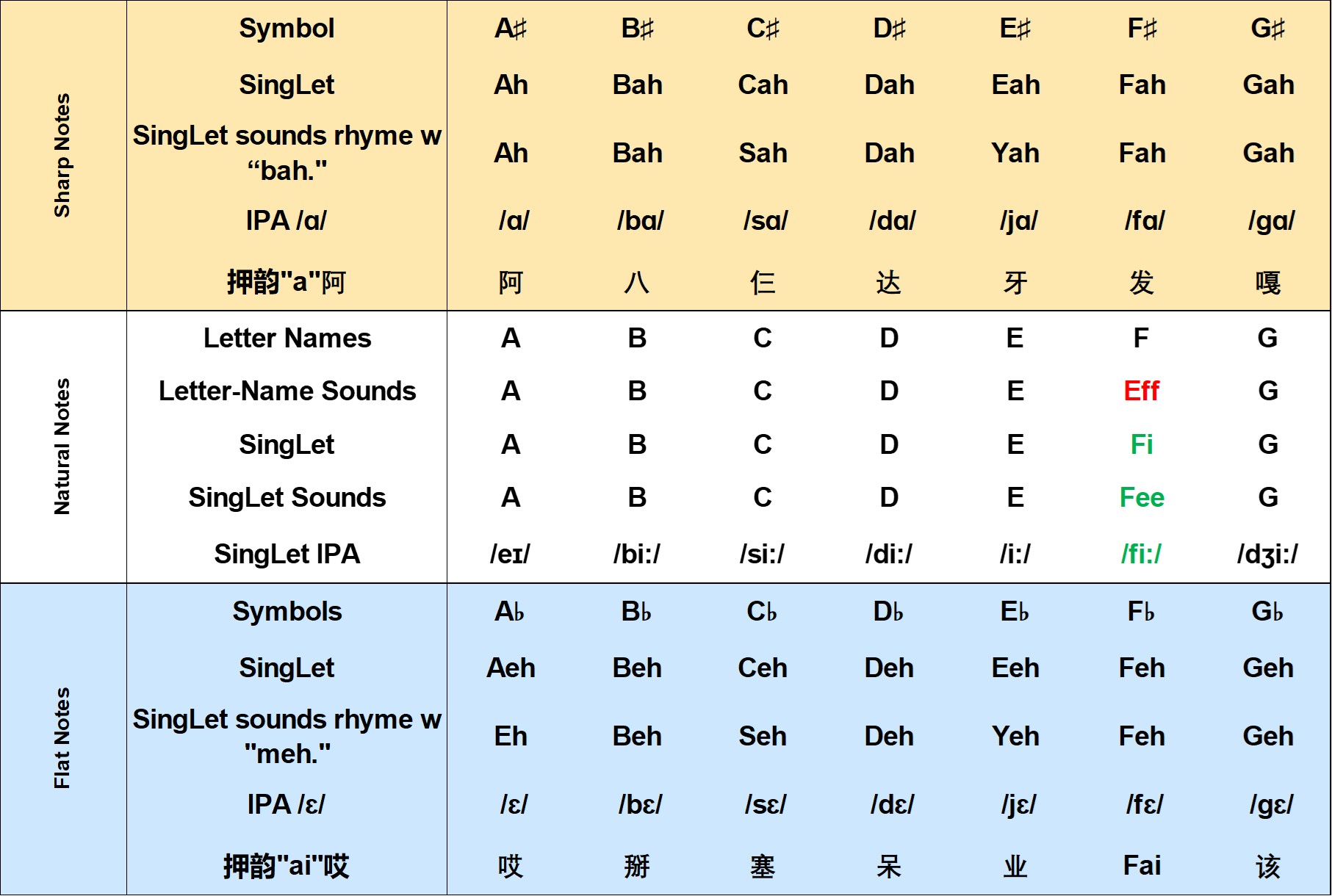
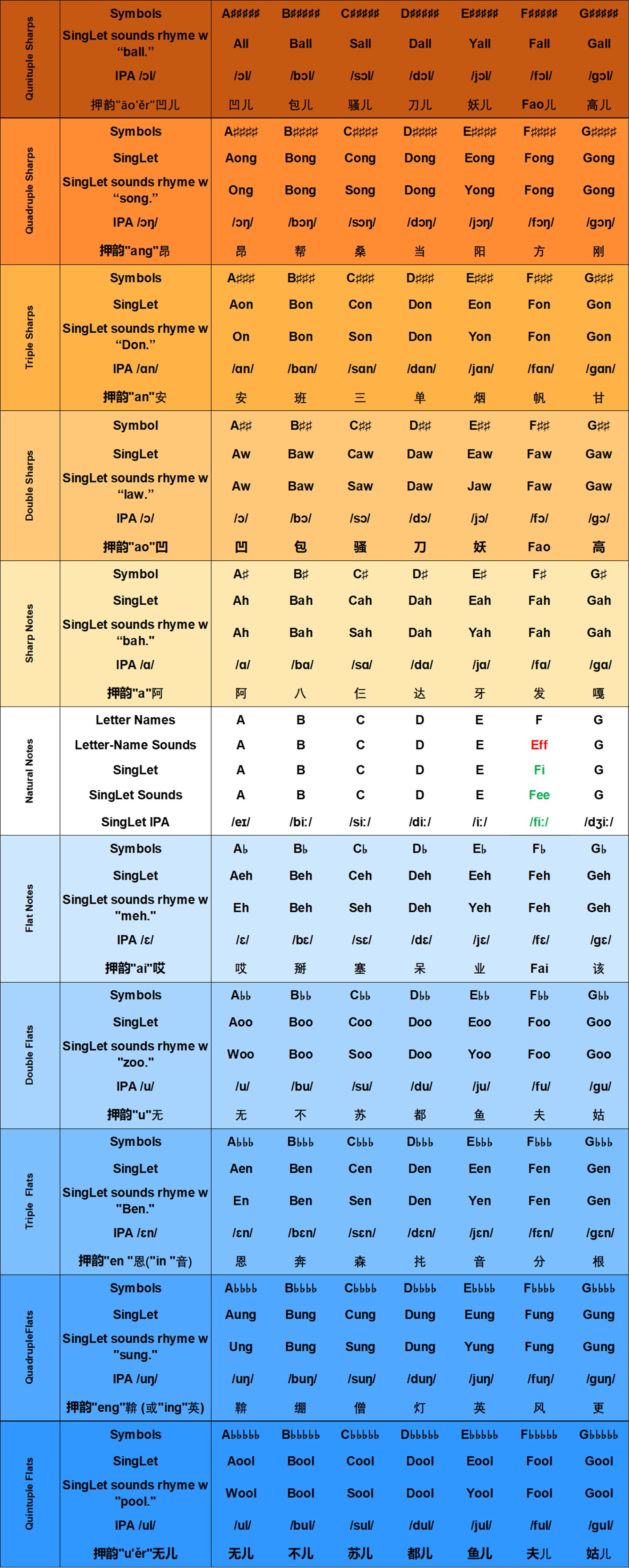
Natural SingLets™ are A, B, C, D, E, Fi, and G. Their pronunciations are the familiar English letter names, except that F becomes Fi /fi:/.
Only F shifts away from its ordinary letter-name pronunciation, changing /ɛf/ into the smoother /fi:/. This keeps the natural-note layer closely tied to familiar letter identities while improving singability where it matters most.
Note
A
B
C
D
E
F (eff)
G
SingLet
A
B
C
D
E
Fi
G
SingLet sounds
A
Bee
Cee
Dee
Ee
Fi
Gee
SingLet IPA
/eɪ/
/bi:/
/si:/
/di:/
/i:/
/fi:/
/dʒi:/
Sharp and Flat Accidentals
Each letter note family keeps a consistent starting sound across all accidental SingLets™, so the note family stays easy to recognize. Specifically:
- The B, C, D, F, and G families keep the same initial consonant sounds as their English letter names: /b/, /s/, /d/, /f/, and /dʒ/ or /g/. The C family always uses the /s/ beginning sound. The G family may use either /dʒ/ or /g/ beginning sound, because the “G /g/” onset preserves the visual connection to letter G more directly, while the “J /dʒ/” onset links to the sound of letter G more. - The E family uses the /j/ sound, as in “yes” (/jɛs/). - The A family begins directly with the vowel. When an initial A is written, it marks the A family in spelling only and does not add a separate sound.
The sharp and flat forms then differ mainly in their ending vowels: the sharp tier (first tier) uses the "ah" sound in "sharp" (/ɑ/), while the flat tier (first tier) uses the "eh" sound in "meh" (/ɛ/), because vowel /æ/ as in “flat” never appears as an ending sound in normal English vocabularies.
Sharp
Sharp SingLets™ are A♯→Ah, B♯→Bah, C♯→Cah, D♯→Dah, E♯→Eah, F♯→Fah, and G♯→Gah, all ending in the vowel sound /ɑ/, as in “sharp /ʃɑɹp/”, here spelled “ah”.
Note
A♯
B♯
C♯
D♯
E♯
F♯
G♯
SingLet
Ah
Bah
Cah
Dah
Eah
Fah
Gah
IPA
/ɑ/
/bɑ/
/sɑ/
/dɑ/
/jɑ/
/fɑ/
/gɑ/
Flat
Flat SingLets™ are A♭→Aeh, B♭→Beh, C♭→Ceh, D♭→Deh, E♭→Eeh, F♭→Feh, and G♭→Geh, all sharing the ending sound /ɛ/ as in “meh”, here assigned to the syllable “eh.”
Note
A♭
B♭
C♭
D♭
E♭
F♭
G♭
SingLet
Aeh
Beh
Ceh
Deh
Eeh
Feh
Geh
IPA
/ɛ/
/bɛ/
/sɛ/
/dɛ/
/jɛ/
/fɛ/
/gɛ/
(In standard English, neither vowel /æ/ as in “flat” nor /ɛ/ as in “meh” appear lexically in final position. However, vowel /ɛ/ as final interjections & discourse forms at the end of a word or syllable is more common in pragmatic speech than vowel /æ/.)
Double Sharp and Flat Accidentals
This second tier keeps the same starting sounds while shifting to darker, rounder endings, such as the "aw" sound in "law" and the "oo" sound in "zoo."
Sharp
Double-sharp SingLets™ are A♯♯→Aw, B♯♯→Baw, C♯♯→Caw, D♯♯→Daw, E♯♯→Eaw, F♯♯→Faw, and G♯♯→Gaw, all sharing the ending sound /ɔ/, as in “law.”
Note
A♯♯
B♯♯
C♯♯
D♯♯
E♯♯
F♯♯
G♯♯
SingLet
Aw
Baw
Caw
Daw
Eaw
Faw
Gaw
IPA
/ɔ/
/bɔ/
/sɔ/
/dɔ/
/jɔ/
/fɔ/
/gɔ/
Flat
Double-flat SingLets™ are A♭♭→Aoo, B♭♭→Boo, C♭♭→Coo, D♭♭→Doo, E♭♭→Eoo, F♭♭→Foo, and G♭♭→Goo, all sharing the ending sound /u/, as in “zoo.”
Note
A♭♭
B♭♭
C♭♭
D♭♭
E♭♭
F♭♭
G♭♭
SingLet
Aoo
Boo
Coo
Doo
Eoo
Foo
Goo
IPA
/u/
/bu/
/su/
/du/
/ju/
/fu/
/gu/
Triple Sharp and Flat Accidentals
This third tier adds a final /n/ sound to the first-tier endings while keeping the same starting sounds and sharp-versus-flat contrast. In this tier, C♯♯♯→Con and C♭♭♭→Cen keep the SingLet /s/ sound rather than the ordinary English /k/.
Sharp
Triple-sharp SingLets™ are A♯♯♯→Aon, B♯♯♯→Bon, C♯♯♯→Con, D♯♯♯→Don, E♯♯♯→Eon, F♯♯♯→Fon, and G♯♯♯→Gon, all sharing the ending sound /ɑn/, as in “Don.” C♯♯♯→Con is pronounced /sɑn/ as a SingLet rather than /kɑn/ as a normal English word.
Note
A♯♯♯
B♯♯♯
C♯♯♯
D♯♯♯
E♯♯♯
F♯♯♯
G♯♯♯
SingLet
Aon
Bon
Con
Don
Eon
Fon
Gon
IPA
/ɑn/
/bɑn/
/sɑn/
/dɑn/
/jɑn/
/fɑn/
/gɑn/
Flat
Triple-flat SingLets™ are A♭♭♭→Aen, B♭♭♭→Ben, C♭♭♭→Cen, D♭♭♭→Den, E♭♭♭→Een, F♭♭♭→Fen, and G♭♭♭→Gen, all sharing the ending sound /ɛn/, as in “pen.” C♭♭♭→Cen is pronounced /sɛn/ rather than /kɛn/ in ordinary English.
Note
A♭♭♭
B♭♭♭
C♭♭♭
D♭♭♭
E♭♭♭
F♭♭♭
G♭♭♭
SingLet
Aen
Ben
Cen
Den
Een
Fen
Gen
IPA
/ɛn/
/bɛn/
/sɛn/
/dɛn/
/jɛn/
/fɛn/
/gɛn/
Quadruple Sharp and Flat Accidentals
The quadruple tier adds a final /ŋ/ sound to the second-tier endings while keeping the same starting sounds and sharp-versus-flat contrast.
Sharp
Quadruple-sharp SingLets™ are A♯♯♯♯→Aong, B♯♯♯♯→Bong, C♯♯♯♯→Cong, D♯♯♯♯→Dong, E♯♯♯♯→Eong, F♯♯♯♯→Fong, and G♯♯♯♯→Gong, all sharing the ending sound /ɔŋ/, as in the English word “song,” not the Chinese Pinyin “Song” (宋).
Note
A♯♯♯♯
B♯♯♯♯
C♯♯♯♯
D♯♯♯♯
E♯♯♯♯
F♯♯♯♯
G♯♯♯♯
SingLet
Aong
Bong
Cong
Dong
Eong
Fong
Gong
IPA
/ɔŋ/
/bɔŋ/
/sɔŋ/
/dɔŋ/
/jɔŋ/
/fɔŋ/
/gɔŋ/
Flat
Quadruple-flat SingLets™ are A♭♭♭♭→Aung, B♭♭♭♭→Bung, C♭♭♭♭→Cung, D♭♭♭♭→Dung, E♭♭♭♭→Eung, F♭♭♭♭→Fung, and G♭♭♭♭→Gung, all sharing the ending sound /uŋ/, as “ung” in “sung” or “lung.” The close similarity in Chinese would be “eng” as 僧 or “ing” 英.
Note
A♭♭♭♭
B♭♭♭♭
C♭♭♭♭
D♭♭♭♭
E♭♭♭♭
F♭♭♭♭
G♭♭♭♭
SingLet
Aung
Bung
Cung
Dung
Eung
Fung
Gung
IPA
/uŋ/
/buŋ/
/suŋ/
/duŋ/
/juŋ/
/fuŋ/
/guŋ/
Quintuple Sharp and Flat Accidentals
The quintuple tier adds a final /l/ sound to the second-tier endings while keeping the same starting sounds and sharp-versus-flat contrast.
Sharp
Quintuple-sharp SingLets™ are A♯♯♯♯♯→All, B♯♯♯♯♯→Ball, C♯♯♯♯♯→Call, D♯♯♯♯♯→Dall, E♯♯♯♯♯→Eall, F♯♯♯♯♯→Fall, and G♯♯♯♯♯→Gall, all sharing the ending sound /ɔl/, as in “ball.”
Note
A♯♯♯♯♯
B♯♯♯♯♯
C♯♯♯♯♯
D♯♯♯♯♯
E♯♯♯♯♯
F♯♯♯♯♯
G♯♯♯♯♯
SingLet
All
Ball
Call
Dall
Eall
Fall
Gall
IPA
/ɔl/
/bɔl/
/sɔl/
/dɔl/
/jɔl/
/fɔl/
/gɔl/
Flat
Quintuple-flat SingLets™, if ever remotely needed, can be A♭♭♭♭♭→Aool, B♭♭♭♭♭→Bool, C♭♭♭♭♭→Cool, D♭♭♭♭♭→Dool, E♭♭♭♭♭→Eool, F♭♭♭♭♭→Fool, and G♭♭♭♭♭→Gool, all sharing the ending sound /ul/, as in “cool.”
Note
A♭♭♭♭♭
B♭♭♭♭♭
C♭♭♭♭♭
D♭♭♭♭♭
E♭♭♭♭♭
F♭♭♭♭♭
G♭♭♭♭♭
SingLet
Aool
Bool
Cool
Dool
Eool
Fool
Gool
IPA
/ul/
/bul/
/sul/
/dul/
/jul/
/ful/
/gul/
Pattern Summary
Among the seven natural-note SingLets™, there is only one new form to learn: the letter F changes from its alphabetic pronunciation /ɛf/ to the SingLet Fi /fiː/.
When progressing to sharp and flat accidentals, most learners need only make two adjustments: E-family accidentals begin with the "y" sound /j/, and the first-tier endings use the "ah" sound for sharps and the "eh" sound for flats.
For advanced theory and specialized applications, the system extends from the seven natural notes through quintuple accidentals. Across seven letter note families and eleven distinct Let forms, this yields 77 SingLets™ (7 × 11). Every SingLet™ remains a monosyllable with a single, uninterrupted articulatory gesture.
Accidental direction and tier are encoded through systematic ending-sound shifts. Natural notes end with /iː/. Single and double sharps move toward endings like the sounds in "sharp" and "law," while flats move toward endings like the sounds in "meh" and "zoo." Higher accidental tiers extend this pattern to endings such as /ɑn/, /ɔŋ/, /ɔl/, /ɛn/, /uŋ/, and /ul/.
Should accidentals beyond the fifth tier ever become necessary, such as sextuple accidentals, corresponding SingLets™ can be generated according to the same systematic principles.
The SingLet™ row and SingLet™ syllables such as Fi, Cah, and Fah use the branded syllable family. Note names, staff notation, and the other comparison rows remain in their conventional forms for readability.