From a rare gift to a spectrum of abilities
Absolute pitch (AP) is often said to occur in just 1 out of 10,000 people (0.01%), an estimate reported by Levitin and Rogers. We consider this probably too pessimistic as a description of the full range of AP-related abilities: a definition centered on exceptionally accurate, reference-free pitch naming may overlook partial, emerging, or context-dependent capabilities. This is our interpretation of the estimate's limitations, not a revised population estimate or a claim that the original figure specifically measured our proposed AP5 level. (Levitin and Rogers 2005)
Research supports considering a continuum of AP performance. In computerized testing of 51 musicians, Bermudez and Zatorre found performance ranging from perfect to random, with a substantial group showing intermediate proficiency. They also emphasized that test design and scoring affect the distribution observed. Separately, Levitin's work showed that memory for the pitch of familiar music can exist without conventional pitch labeling. Together, these findings motivate a broader account of pitch abilities, although they do not establish how common each ability is in the general population. (Bermudez and Zatorre 2009); (Levitin 1994)
Language proficiency offers a useful analogy for classifying continuous ability. The U.S. Interagency Language Roundtable (ILR) scale uses six base levels, numbered 0 through 5. The Department of Defense's April 2022 speaking descriptors name them: 0, “No Proficiency”; 1, “Elementary Proficiency”; 2, “Limited Working Proficiency”; 3, “General Professional Proficiency”; 4, “Advanced Professional Proficiency”; and 5, “Functionally Native Proficiency.” Intermediate plus ratings, from 0+ to 4+, recognize performance between base levels. (Defense Language and National Security Education Office 2022) Europe's Common European Framework of Reference for Languages (CEFR) offers a similar approach with levels A1-C2, grouped into basic, independent, and proficient language use. (Council of Europe n.d.)
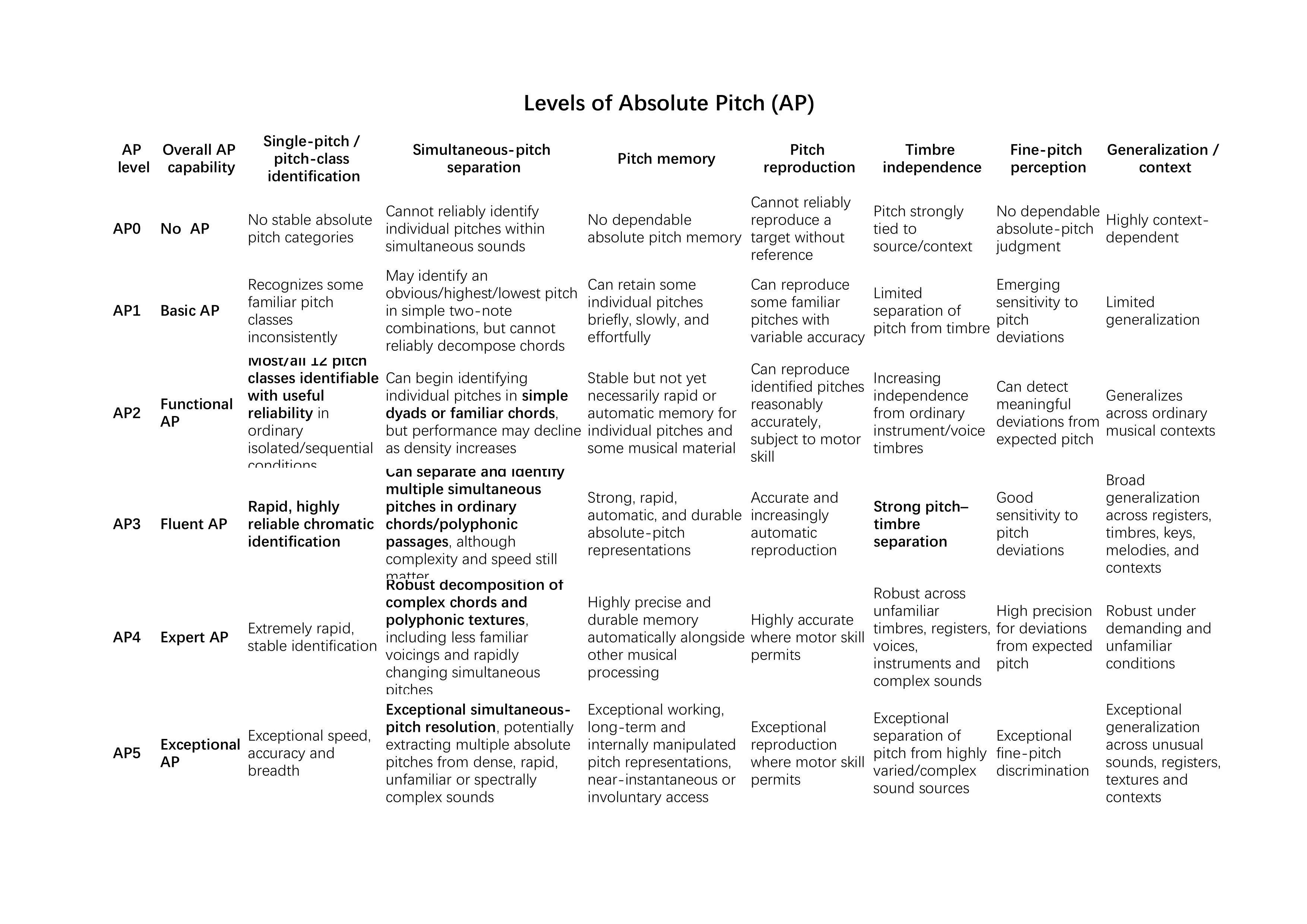
We propose the AP Levels table below, drawing on evidence for a continuum of AP ability and the analogy to the ILR's 0-5 classification. The levels describe useful capabilities across a range of proficiency; they do not imply a direct equivalence between language and AP ratings.
Using the framework
Van Hedger, Heald, and Nusbaum found that some adults achieved strong AP performance after training, while most participants made modest gains. Their findings support investigating learning while recognizing individual differences. (Van Hedger, Heald, and Nusbaum 2019)
Record a profile across dimensions rather than forcing every listener into one row. Specify the pitch set, tuning, register, timbres, number of trials, response time, and scoring rules. Test without a supplied reference, record possible internal-reference strategies, and assess naming, reproduction, and simultaneous-pitch identification separately. Repeated sessions can help distinguish stable performance from a single successful attempt.